Small Businesses Lead Australia’s AI Adoption Surge, New Research Shows
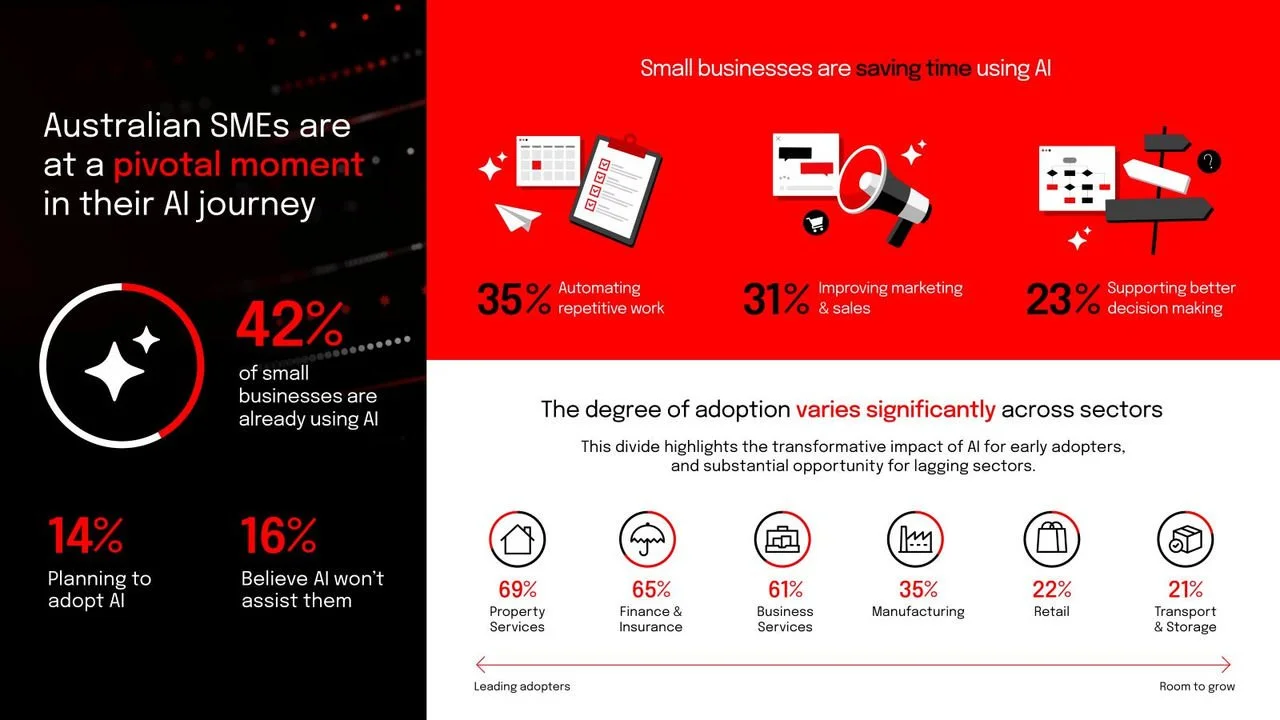
Image source: NAB
Australia’s small and medium businesses (SMEs) are emerging as the driving force behind the nation’s next wave of artificial intelligence adoption, as new research points to a shift from early experimentation to everyday use.
According to findings from NAB Economics, 42% of Australian SMEs are already using AI, with a further 14% planning to adopt the technology. The data suggests that AI is no longer confined to large enterprises, with smaller operators increasingly integrating it into core business activities.
From administration and marketing to decision-making, SMEs are applying AI tools in practical ways, with one of the most immediate benefits being time savings. For many business owners, this translates not only into operational efficiencies, but also more time to focus on growth or personal priorities.
Despite this momentum, adoption is far from universal. Almost half of SMEs (44%) are not yet using AI, highlighting a significant opportunity to expand capability across the sector. Given that SMEs account for more than 98% of all Australian businesses, broader uptake could play a meaningful role in lifting national productivity.
Pete Steel said the latest findings reflect a growing confidence among business owners in using AI as a practical tool rather than an abstract concept.
“We’re seeing a clear shift from curiosity to practical use, with more businesses using AI to save time, reduce admin burdens and make better decisions,” Mr Steel said.
“Unlocking this adoption at scale across the economy has real potential to help Australia increase productivity and lift our global competitiveness.
“Australians have long demonstrated themselves as early adopters of technology and this research shows that mindset in action, they’re embracing AI, not scared of it.
“The opportunity now is to help many more companies through something that feels complex and uncertain - to adopt this technology safely and with confidence. Whether they are bakeries managing orders, wineries forecasting demand or restaurants reducing admin, this technology can help deliver real benefits for themselves and the broader Australian economy.
“It’s encouraging to see the Government supporting this growing appetite through offerings like the National AI Centre ‘AI Adopt’ and ‘Digital Solutions’ programs that offer tailored advice for businesses to help them achieve productivity benefits.”
Early adopters demonstrate real-world impact
For businesses already using AI, the shift has been both practical and measurable.
Tim Gauci, owner of Design and Diplomacy, said initial scepticism gave way to tangible results once he invested time in understanding how to apply the technology.
“I invested time in understanding what AI is and how to use it properly in the context of my business, so the outputs were actually useful,” he said.
“If you want more free time, you need to work out how to use it. It doesn’t take long.”
Similarly, Andrew Blair, director of Bella Manufacturing, said hands-on learning helped overcome early assumptions that AI was only suited to technical specialists.
“We’re using AI across marketing, sales, operations and logistics,” Mr Blair said. “The real value isn’t the technology. It’s the time it gives back.”
From early adopters to mainstream use
The findings point to a broader transition underway, as AI adoption moves beyond early adopters into the wider SME community. While challenges remain around confidence, capability and implementation, the trajectory suggests AI is becoming an increasingly standard part of how small businesses operate.
As adoption spreads, the focus is likely to shift from experimentation to optimisation, with businesses looking to embed AI more deeply into workflows and decision-making. For Australia’s SME sector, the opportunity lies not just in adopting the technology, but in using it effectively to unlock productivity gains at scale.